The Berfîn: what the eight-pointed star actually means
It appears on kilims woven in mountain villages. It appears on ceramic tiles, on doorframes, on shepherd's bags. The Berfîn — the Kurdish word for snowflake — is one of the most documented symbols in Kurdish visual culture. Here is what it holds.
Geometry as memory
The eight-pointed star is not decorative. It is structural. Eight points radiating from a single center — a geometry that encodes how Kurdish mountain communities organized themselves: around shared centers, wells, fires, elders, seasons.
Kurdish kilim weavers — predominantly women — were often illiterate by the standards of formal education. They did not need to be. The geometry held the knowledge. A kilim was a document, woven rather than written. The Berfîn appeared in it as a marker of balance and communal harmony.
Why "Berfîn"
In Kurmanji Kurdish, berfîn means snowflake. The eight-branch symmetry of a snowflake and the eight-pointed star share the same visual logic — radial, balanced, built outward from a center. The word transfers the natural world into the woven one. A snowflake does not accumulate. It arrives exactly formed. The Berfîn motif carries that completeness.
How we use it at HEZAR K
We kept the original geometry of the Berfîn. We did not smooth the angles, did not modernize the proportions. We did not add anything that was not already there. We printed it larger — on ring-spun cotton, in terracotta, so it could be worn rather than walked on.
Every detail is documented. We can trace the specific kilim tradition this variant comes from. That is what "Kurdistan Heritage" means to us: not a label, but a method.
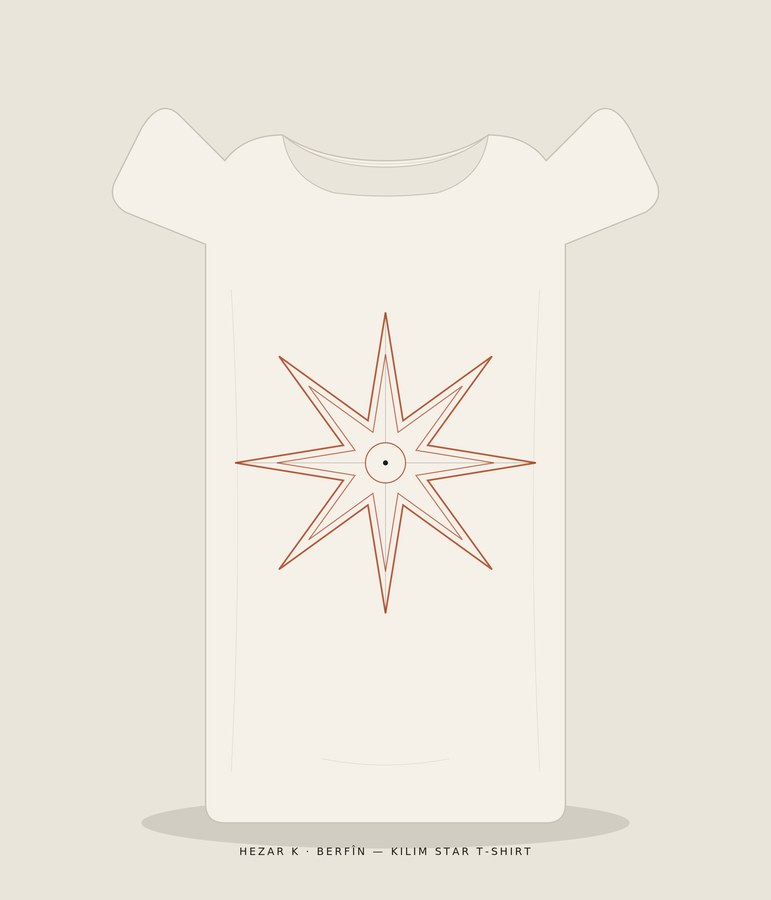
Berfîn — Kilim Star T-shirt
Ring-spun cotton · Terracotta on natural · XS–3XL · 27,90 €
Shop this pieceFurther reading
The documentation of Kurdish kilim motifs has been carried forward by researchers including Yanni Petsopoulos (Kilims: Flat-Woven Tapestry Rugs, 1982) and more recently by regional textile preservation initiatives in Diyarbakır and Sulaymaniyah. The Berfîn appears consistently across Kurdish weaving regions — Kurmanci-speaking areas in Turkey, Iran, Iraq, and Syria — which suggests it predates the political fragmentation of the region.