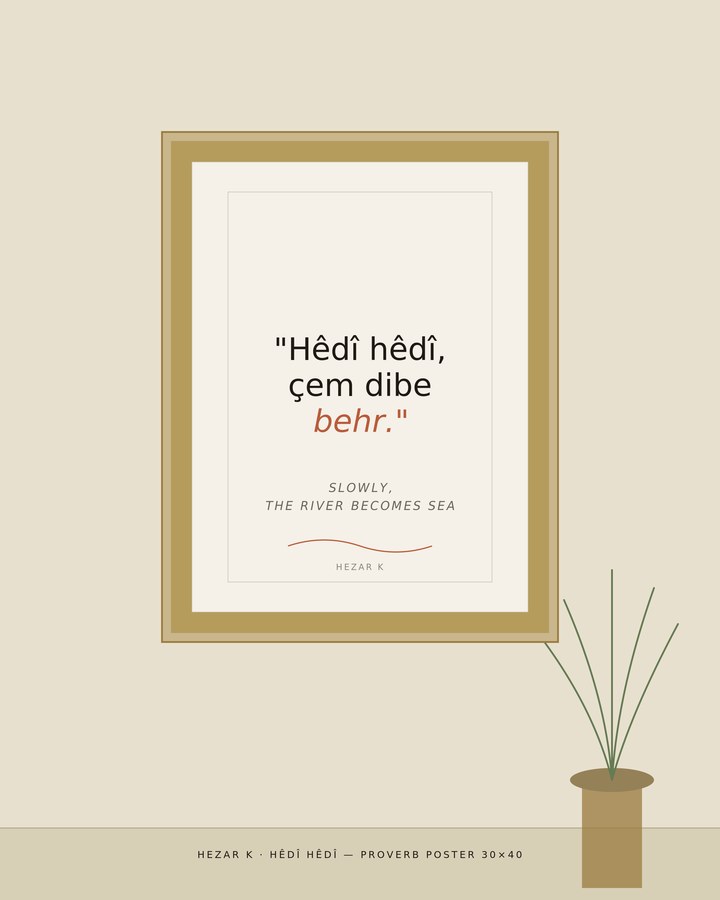
"Hêdî hêdî, çem dibe behr."
Slowly, the river becomes sea. Six words in Kurmanji that carry an entire philosophy of time, effort, and becoming.
The literal meaning
Hêdî means slowly. Çem is river. Dibe is becomes. Behr is sea. The grammar is simple. The image is not.
A river does not decide to become a sea. It does not accelerate, does not force. It moves within its course, consistently, and the accumulation of that movement becomes something entirely different from its origin. The proverb is not about patience in the passive sense — waiting for something to happen. It is about sustained, quiet motion becoming transformation.
Where it comes from
The proverb is documented across Kurmanji-speaking regions — southeastern Turkey, northern Iraq, northwestern Iran, northern Syria. It is carried primarily in oral tradition, transmitted by dengbêj singers and village elders. The rivers it references are not metaphorical: the Tigris, the Euphrates, the Khabur — rivers that Kurdish communities have lived alongside for millennia, rivers that do become seas, that reach the Persian Gulf or the Mediterranean after thousands of kilometers.
The geography is in the language. You cannot fully understand this proverb without knowing that Kurdish people have watched actual rivers become actual seas over generations.
Why we put it on a poster
When we were designing the first HEZAR K pieces, this proverb chose itself. It is the spirit behind how we work — slowly, without shortcuts, without stereotypes. Each motif documented. Each proverb sourced. Each piece made individually.
We printed it on 200gsm matte paper because we wanted the object to last. A proverb that has survived centuries of oral transmission deserves a frame.